Angular Signals in Enterprise Apps: A Practical State Architecture Without Overusing Global Stores
Learn how to use Angular Signals for enterprise state management with feature stores, RxJS boundaries, migration patterns, and governance rules.
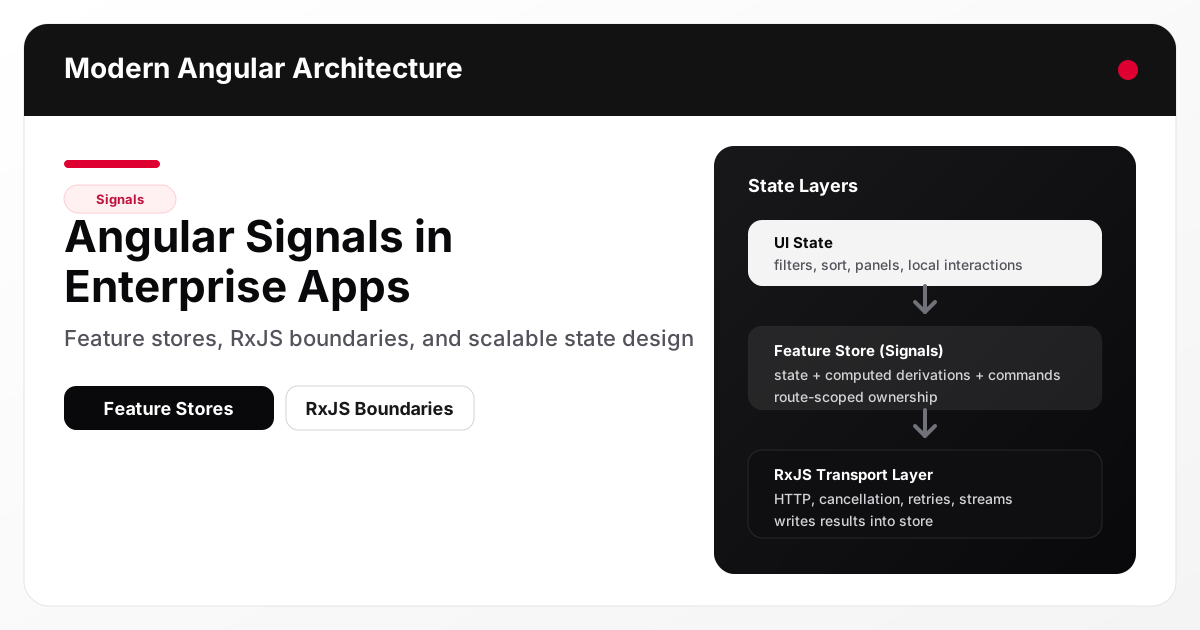
Angular Signals are a strong fit for enterprise Angular applications when you use them as a feature-level state primitive, not as a universal replacement for every reactive pattern. The practical model is: keep UI and derived state in signals, keep async orchestration and transport concerns in RxJS, and reserve app-wide state for truly cross-cutting concerns. This approach reduces global-store sprawl, improves local reasoning, and still supports large-team governance.
Why enterprise teams over-rotate to a global store
Many teams experience a real pain point first: component state becomes scattered, duplicated, and hard to test. The common reaction is to centralize everything in a single global store. That move solves some problems, but it also creates others:
- Increased ceremony for small feature changes
- More coupling between unrelated features
- Slower onboarding because business logic is far from the route that uses it
- Selectors and actions that become an indirect language for simple interactions
Signals give you a better middle ground for many features. They let you keep state close to the feature boundary while still exposing a clean reactive API to components.
What Signals are good at (and where they are not)
Strong use cases for Signals
Signals are particularly effective for:
- Local UI state (filters, tab state, sort order, panel visibility)
- Feature state loaded from APIs and transformed for the view
- Derived state (
computed) that would otherwise become selector boilerplate - Template reactivity with predictable updates
Where RxJS should remain the primary tool
Signals are not a replacement for streaming workflows. RxJS remains the right tool for:
- Cancellation (
switchMap) - Retries/backoff
- WebSocket/event streams
- Complex async orchestration
- Debouncing/throttling input streams
- Multi-source stream composition over time
A mature architecture uses both.
A boundary-first enterprise state model
A practical model for enterprise Angular teams is to define state in layers:
- Component UI state: local interaction and presentational concerns
- Feature store state: route/domain state for a feature slice
- Application state: auth/session/preferences and other cross-cutting concerns
- Server state / transport: API fetching, retries, caching orchestration (usually RxJS)
This layered model prevents the “everything becomes global” anti-pattern.
Rule of thumb
If a state value is only used within one route or feature boundary, start with a route-scoped feature store, not a global store.
Example 1: Route-scoped feature store with Signals (Angular 21+)
This pattern keeps domain state close to the feature route and exposes a stable read/write API.
import { Injectable, computed, signal } from '@angular/core';

export interface ProjectSummary {
  id: string;
  name: string;
  status: 'active' | 'archived';
  owner: string;
}

interface ProjectListState {
  items: ProjectSummary[];
  loading: boolean;
  error: string | null;
  query: string;
}

@Injectable()
export class ProjectListStore {
  private readonly state = signal<ProjectListState>({
    items: [],
    loading: false,
    error: null,
    query: ''
  });

  readonly items = computed(() => this.state().items);
  readonly loading = computed(() => this.state().loading);
  readonly error = computed(() => this.state().error);
  readonly query = computed(() => this.state().query);

  readonly filteredItems = computed(() => {
    const { items, query } = this.state();
    const q = query.trim().toLowerCase();
    if (!q) {
      return items;
    }
    return items.filter((project) => project.name.toLowerCase().includes(q));
  });

  readonly activeCount = computed(
    () => this.state().items.filter((item) => item.status === 'active').length
  );

  setQuery(query: string): void {
    this.patch({ query });
  }

  setLoading(loading: boolean): void {
    this.patch({ loading });
  }

  setItems(items: ProjectSummary[]): void {
    this.patch({ items, error: null });
  }

  setError(message: string): void {
    this.patch({ error: message, loading: false });
  }

  private patch(partial: Partial<ProjectListState>): void {
    this.state.update((current) => ({ ...current, ...partial }));
  }
}
Why this works in enterprise codebases
- State shape is explicit and testable
- Reads are separated from writes
- Derived values are colocated with source state
- No action/reducer boilerplate for simple feature state
Example 2: Keep async orchestration in RxJS, bridge into Signals
A common mistake is forcing network orchestration into signals-only code. A better approach is to keep the async workflow in RxJS and write the result into a feature store.
import { Injectable, inject } from '@angular/core';
import { HttpClient } from '@angular/common/http';
import { Subject, catchError, debounceTime, distinctUntilChanged, finalize, of, switchMap, tap } from 'rxjs';

import { ProjectListStore, ProjectSummary } from './project-list.store';

@Injectable()
export class ProjectListFacade {
  private readonly http = inject(HttpClient);
  private readonly store = inject(ProjectListStore);
  private readonly searchRequests = new Subject<string>();

  constructor() {
    this.searchRequests
      .pipe(
        debounceTime(200),
        distinctUntilChanged(),
        tap((query) => {
          this.store.setQuery(query);
          this.store.setLoading(true);
        }),
        switchMap((query) =>
          this.http
            .get<ProjectSummary[]>('/api/projects', {
              params: { q: query }
            })
            .pipe(
              tap((items) => this.store.setItems(items)),
              catchError(() => {
                this.store.setError('Failed to load projects.');
                return of([]);
              }),
              finalize(() => this.store.setLoading(false))
            )
        )
      )
      .subscribe();
  }

  search(query: string): void {
    this.searchRequests.next(query);
  }
}
This split keeps transport logic where RxJS shines while preserving the ergonomic template experience of signals.
Example 3: Route-scoped providers with standalone routing
In Angular 21+, route-level providers make feature ownership and lifecycle boundaries much cleaner.
import { Routes } from '@angular/router';

import { ProjectListFacade } from './data/project-list.facade';
import { ProjectListStore } from './data/project-list.store';

export const PROJECT_ROUTES: Routes = [
  {
    path: '',
    providers: [ProjectListStore, ProjectListFacade],
    loadComponent: () =>
      import('./project-list.page').then((m) => m.ProjectListPageComponent)
  }
];
This improves both architecture and performance:
- Stores are created only when the feature route is loaded
- Feature state is disposed when the route is destroyed (depending on route reuse behavior)
- Cross-feature mutation is harder by default
Example 4: Component integration with signals (without over-abstracting)
import { ChangeDetectionStrategy, Component, inject } from '@angular/core';
import { FormsModule } from '@angular/forms';

import { ProjectListFacade } from './data/project-list.facade';
import { ProjectListStore } from './data/project-list.store';

@Component({
  selector: 'app-project-list-page',
  standalone: true,
  imports: [FormsModule],
  template: `
    <section>
      <h1>Projects</h1>
      <input
        type="search"
        [ngModel]="store.query()"
        (ngModelChange)="facade.search($event)"
        placeholder="Search projects"
      />

      @if (store.loading()) {
        <p>Loading...</p>
      }

      @if (store.error(); as error) {
        <p>{{ error }}</p>
      }

      <p>Active projects: {{ store.activeCount() }}</p>

      <ul>
        @for (project of store.filteredItems(); track project.id) {
          <li>{{ project.name }} ({{ project.status }})</li>
        }
      </ul>
    </section>
  `,
  changeDetection: ChangeDetectionStrategy.OnPush
})
export class ProjectListPageComponent {
  readonly store = inject(ProjectListStore);
  readonly facade = inject(ProjectListFacade);
}
Enterprise migration strategy: from selector-heavy state to Signals
Most teams cannot rewrite state architecture in one sprint. A safer migration path is incremental.
Phase 1: Convert derived read models first
Start by converting simple selectors into computed values inside route-scoped stores. Keep the external feature API stable.
Phase 2: Keep global store for cross-cutting concerns
Do not migrate auth, global permissions, or tenant context just for consistency. Move only what benefits from local feature ownership.
Phase 3: Introduce governance rules
Create standards for:
- Store naming (
FeatureStore,FeatureFacade) - Read-only signal exposure patterns
- Async boundaries (RxJS for network/event streams)
- Route-scoped provider defaults
- Testing conventions for computed state
Anti-patterns to avoid
1. Replacing all RxJS with Signals
This usually creates custom async state machinery that is harder to reason about than standard RxJS operators.
2. Exposing writable signals publicly
Public writable signals allow uncontrolled mutation across the app. Expose read APIs and methods instead.
3. Globalizing feature state too early
If a feature store is only used by one route, putting it in app-wide scope increases coupling and reduces modularity.
4. Overloaded computed chains
Deep computed chains with expensive filtering/mapping can become a hidden performance problem. Profile and split work when needed.
When to use Signals vs a global store
Use Signals-first feature stores when:
- State is primarily route/feature-scoped
- You need strong template ergonomics
- Derived state is mostly synchronous
- Team wants less boilerplate for medium-complexity features
Use (or keep) a global store when:
- State is truly shared across many features
- You need event sourcing/time-travel tooling (if your team relies on it)
- Coordination across modules is central to the domain
- Existing store infrastructure is already paying for itself
In many enterprise Angular codebases, the best outcome is a hybrid: global store for cross-cutting domain concerns, signals-based feature stores for route-level UI and feature state.
Implementation checklist (production team)
- Define a default state-layering policy (component, feature, app-wide)
- Make route-scoped providers the default for feature stores
- Keep API/transport orchestration in RxJS
- Expose read-only signals and imperative methods only
- Add tests for computed state and mutation methods
- Document when global state is allowed
- Add PR review checks for cross-feature state mutation
Common mistakes
- Using signals to emulate streaming operators (
switchMap, retry, cancellation) - Sharing writable signal references across features
- Putting DTOs directly into UI-level derived state without adaptation
- Mixing app-wide and feature concerns in one store class
- Migrating architecture patterns without team conventions or examples
Visuals (add to make the article more attractive)
Visual 1: State layering diagram
- Placement: after
## A boundary-first enterprise state model - Purpose: show component vs feature vs app-wide vs transport boundaries
- Alt text:
Layered Angular state architecture showing component UI state, feature signals store, app-wide state, and RxJS transport layer - Filename:
/images/articles/angular-signals-state-layering-diagram.webp
Visual 2: RxJS-to-Signals data flow diagram
- Placement: after
## Example 2: Keep async orchestration in RxJS, bridge into Signals - Purpose: illustrate API request stream, cancellation, store updates, and template reads
- Alt text:
Angular feature facade using RxJS for HTTP orchestration and Signals for view state - Filename:
/images/articles/angular-signals-rxjs-bridge-flow.webp
Visual 3: Route-scoped provider lifecycle diagram
- Placement: after
## Example 3: Route-scoped providers with standalone routing - Purpose: explain feature store creation/disposal tied to lazy routes
- Alt text:
Lazy route lifecycle showing route-scoped Angular Signal store instantiation and teardown - Filename:
/images/articles/angular-signals-route-scoped-store-lifecycle.webp
Visual 4: Decision table (signals vs global store)
- Placement: after
## When to use Signals vs a global store - Purpose: summarize decision criteria for enterprise teams
- Alt text:
Comparison table for choosing Angular Signals feature stores versus global application store - Filename:
/images/articles/angular-signals-vs-global-store-decision-table.webp
Internal links to add
- Link to
/articles/angular-enterprise-feature-architecturewhen discussing feature boundaries and route ownership - Link to
/articles/angular-ssr-seo-hydration-playbookfor SSR-aware route-scoping and content delivery considerations - Link to
/articles/angular-cicd-github-actions-deploymentsfrom the checklist section when mentioning PR review and quality gates
FAQ
Are Angular Signals enough for enterprise state management?
For many feature-level use cases, yes. For cross-cutting state and complex event workflows, most enterprise teams still benefit from a hybrid model that uses RxJS (and sometimes a global store) alongside signals.
Should I replace NgRx or another global store with Signals immediately?
Usually no. Start by migrating feature-scoped state and derived selectors where signals reduce boilerplate. Keep stable global-store flows that already work well.
How do Signals and RxJS work together in Angular 21+?
Use RxJS for async orchestration (HTTP, cancellation, retries, streams) and write results into a signals-based feature store for template-friendly derived state.
Do route-scoped stores improve performance?
They can improve startup performance and memory behavior by loading and instantiating feature state only when the lazy route is visited, rather than at application bootstrap.
What is the biggest mistake teams make when adopting Signals?
Treating signals as a universal replacement for all reactive patterns. This often recreates RxJS features poorly and blurs architecture boundaries.
Conclusion and next steps
Angular Signals can simplify enterprise Angular state architecture when used intentionally: keep them close to feature boundaries, pair them with RxJS for async workflows, and enforce team conventions early. The winning pattern for most large codebases is not signals-only or global-store-only, but a clear hybrid architecture that matches the shape of the problem.
Next, review your current feature modules and identify one route-scoped domain where a signals-based feature store can replace selector boilerplate with minimal migration risk. If your app is also content-heavy or SSR-driven, the architecture guidance in Angular SSR + Hydration SEO Playbook is a strong companion read.