Angular vs Next.js for Content Platforms: SEO, SSR, Team Scale, and Operational Tradeoffs
A practical Angular vs Next.js comparison for content platforms covering SEO, SSR, routing, performance, team scale, and deployment operations.
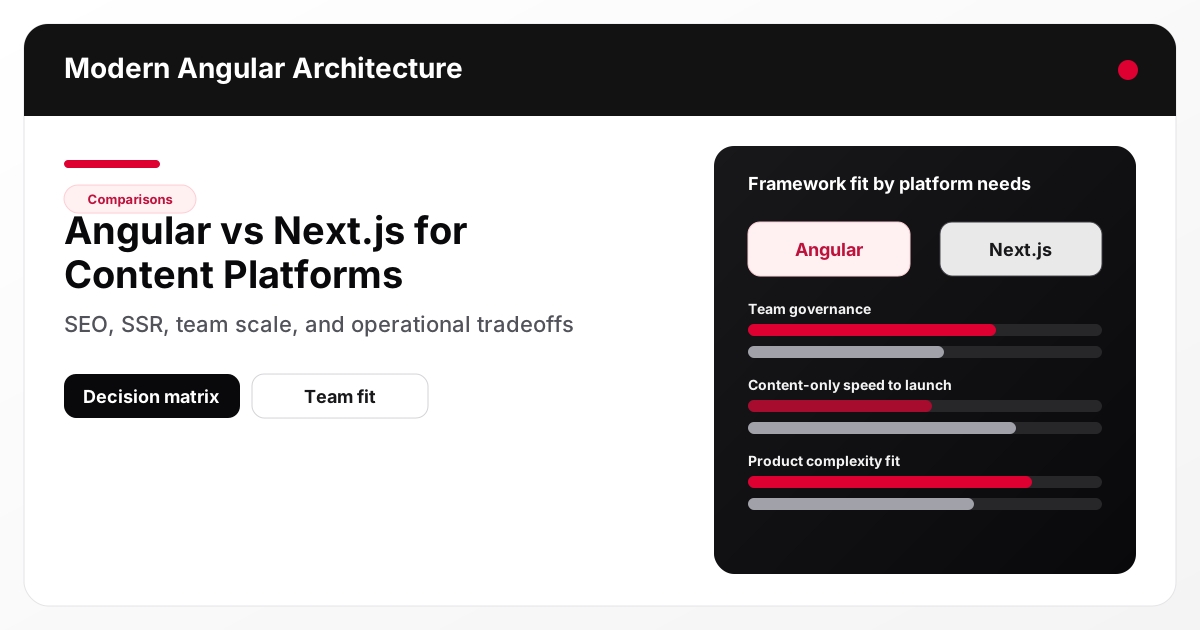
Angular and Next.js can both rank well and power excellent content platforms. The better choice depends less on framework popularity and more on team skill set, architectural consistency needs, operational model, and how much custom product logic lives alongside content. If your organization values strong conventions and a unified framework for app + content surfaces, Angular can be a strong choice. If your team is deeply invested in React and needs fast content-centric iteration, Next.js may reduce time to ship.
Start with decision criteria, not framework marketing
Framework comparisons are often distorted by ecosystem momentum. For a content platform, the real decision should be based on:
- SEO implementation reliability (SSR/prerender/metadata discipline)
- Team expertise and hiring reality
- Complexity of non-content product features
- Operational/deployment model
- Long-term maintainability for multi-team ownership
This article focuses on those factors.
What counts as a “content platform” in practice?
A content platform is more than a blog when it includes combinations of:
- Editorial content (articles, tutorials, docs)
- Search/filtering and taxonomy pages
- Authenticated features (profiles, subscriptions, saved items)
- SEO and social distribution requirements
- Analytics, experimentation, or monetization workflows
The more product behavior you add, the more architecture and governance matter.
Where Angular is strong for content platforms
1. Strong conventions for larger teams
Angular provides built-in primitives for DI, routing, structure, and architecture patterns. This matters when your content site evolves into a product surface with multiple contributors.
2. Unified framework for content + application features
If your company already uses Angular for apps, reusing Angular for a content platform can reduce context switching and tooling fragmentation.
3. Architecture control and explicit boundaries
Standalone APIs, lazy routes, and route-scoped providers make it easier to enforce feature boundaries, which becomes important as the platform grows.
For architecture patterns, see Enterprise Angular Feature Architecture.
Where Next.js is strong for content platforms
1. React ecosystem familiarity
If your team is already shipping React products and design systems, Next.js may offer faster implementation due to shared tooling and developer familiarity.
2. Content-focused developer workflows
Next.js has a mature ecosystem for CMS integrations, MDX workflows, and edge-oriented deployment patterns.
3. Strong defaults for many SEO scenarios
Many teams find Next.js SSR/SSG patterns approachable for content use cases, especially when they are not building large application-like features.
SEO outcome depends more on execution than framework choice
Angular vs Next.js is rarely the determining factor for SEO outcomes. The determining factors are whether your team consistently ships:
- Crawlable HTML on article pages
- Correct metadata per route
- Canonical URLs and structured data
- Sitemap/robots/RSS generation
- Fast, stable pages (LCP/CLS/INP)
- Internal linking and semantic content depth
A poorly implemented Next.js site will underperform a well-implemented Angular site, and vice versa.
Comparison table: Angular vs Next.js for content platforms
| Decision area | Angular | Next.js |
|---|---|---|
| Team scale / governance | Strong conventions help larger teams | Flexible, but can drift without standards |
| SEO capability | Excellent with SSR/prerender + metadata implementation | Excellent with SSR/SSG + metadata implementation |
| Learning curve | Higher if team is new to Angular | Lower if team is already strong in React |
| Architecture primitives | Strong built-in DI/routing patterns | More ecosystem-driven architectural choices |
| Content-only site speed to first version | Can be slower for React-native teams | Often faster for React-native teams |
| Product + content in one codebase | Strong fit when app complexity grows | Also possible, but patterns vary by team |
This is the core decision lens: choose the framework your team can execute well over time.
Example 1: Angular content route with standalone lazy loading
import { Routes } from '@angular/router';

export const routes: Routes = [
  {
    path: 'articles/:slug',
    loadComponent: () =>
      import('./features/articles/article-detail.page').then((m) => m.ArticleDetailPageComponent)
  }
];
Why it matters in the comparison: Angular’s explicit routing and standalone composition make route ownership and architecture reviews straightforward.
Example 2: Angular SSR metadata pattern for article pages
this.seo.setMeta({
  title: article.title,
  description: article.description,
  path: `/articles/${article.slug}`,
  canonicalUrl: this.content.getCanonicalUrl(article),
  type: 'article',
  publishedTime: article.date,
  modifiedTime: article.updated ?? article.date,
  tags: article.tags
});
Why it matters in the comparison: SEO success in Angular is mostly about implementing a disciplined metadata pipeline, not about framework limitations.
Example 3: Build-time SEO artifact generation (framework-agnostic idea, Angular implementation)
await Promise.all([
  fs.writeFile(path.join(publicDir, 'sitemap.xml'), sitemap),
  fs.writeFile(path.join(publicDir, 'rss.xml'), rss),
  fs.writeFile(path.join(publicDir, 'robots.txt'), robots)
]);
This is a good example of how production SEO depends on your content pipeline, regardless of frontend framework.
Team-skill decision framework (practical)
Choose Angular when most of these are true:
- Team is already strong in Angular
- Platform includes significant app-like functionality beyond articles
- You need strong conventions for multi-team collaboration
- You want one framework across internal apps and public content surfaces
Choose Next.js when most of these are true:
- Team is already strong in React/Next.js
- Site is primarily content and CMS-driven
- You need rapid editorial iteration with existing React ecosystem tooling
- Architecture consistency is maintained by an experienced frontend platform team
Operational considerations (often ignored in comparisons)
Framework decisions affect operations more than many teams expect.
Questions to ask
- What is your deployment platform optimized for?
- Who will own CI/CD and runtime debugging?
- How will you validate SSR responses and SEO artifacts after deploy?
- Can the team support performance tuning and observability in the chosen stack?
If you lack a disciplined deployment pipeline, either framework can fail in production. See Angular CI/CD with GitHub Actions for SSR Apps for a workflow model.
When Angular is the wrong choice (for this specific use case)
Angular may be the wrong choice if:
- Your team has no Angular experience and no strategic reason to adopt it
- The site is a lightweight content surface with minimal application behavior
- Speed-to-market is the primary constraint and React/Next capability already exists internally
This is not a critique of Angular; it is an execution-risk assessment.
When Next.js is the wrong choice (for this specific use case)
Next.js may be the wrong choice if:
- Your organization needs stronger standardized architecture across multiple frontend teams
- The platform will accumulate complex app behavior and long-lived domain workflows
- Your team lacks React/Next operational expertise and would be learning under production pressure
Again, this is an execution and governance issue, not a blanket framework judgment.
Decision checklist (use this before committing)
- What is the dominant team skill set today?
- How much non-content product functionality will be built in the next 12 months?
- Do you need framework-level consistency across multiple applications?
- Is your content source markdown-based, CMS-based, or hybrid?
- Who owns SEO implementation and validation in production?
- What is your SSR deployment model and rollback plan?
- Which framework can your team debug at 2 AM after a broken deploy?
Common mistakes in Angular vs Next.js comparisons
- Comparing framework defaults instead of comparing actual team execution capability
- Treating SEO as a framework feature instead of a content + metadata + ops system
- Ignoring CI/CD, rollback, and post-deploy validation requirements
- Overweighting developer preference and underweighting long-term maintenance cost
- Choosing based on tutorials/examples that don’t match your product complexity
Visuals (add to make the article more attractive)
Visual 1: Comparison decision matrix
- Placement: after
## Comparison table: Angular vs Next.js for content platforms - Purpose: summarize framework fit by team skill, product complexity, and governance needs
- Alt text:
Angular versus Next.js decision matrix for content platforms by team and architecture constraints - Filename:
/images/articles/angular-vs-next-content-platform-decision-matrix.webp
Visual 2: Rendering strategy comparison table (SEO-focused)
- Placement: after
## SEO outcome depends more on execution than framework choice - Purpose: compare SSR/prerender/metadata implementation responsibilities in both stacks
- Alt text:
SEO implementation comparison for Angular and Next.js content platforms - Filename:
/images/articles/angular-vs-next-seo-implementation-comparison.webp
Visual 3: Team capability assessment flowchart
- Placement: after
## Team-skill decision framework (practical) - Purpose: guide decision based on existing expertise and platform complexity
- Alt text:
Frontend framework selection flowchart based on team capability and product complexity - Filename:
/images/articles/angular-vs-next-team-capability-flowchart.webp
Visual 4: Operational readiness checklist graphic
- Placement: after
## Operational considerations (often ignored in comparisons) - Purpose: highlight CI/CD, observability, rollback, and runtime validation needs
- Alt text:
Operational readiness checklist for deploying content platforms with Angular or Next.js - Filename:
/images/articles/angular-vs-next-operational-readiness-checklist.webp
Internal links to add
- Link to
/articles/angular-ssr-seo-hydration-playbookfor Angular SSR SEO implementation details - Link to
/articles/angular-enterprise-feature-architecturefor multi-team architecture/governance considerations - Link to
/articles/angular-cicd-github-actions-deploymentsin the operational section - Link to
/articles/angular-signals-enterprise-statewhen discussing app-like feature complexity within content platforms
FAQ
Is Angular good for SEO-heavy content websites?
Yes. Angular can perform very well for SEO-heavy content sites when SSR/prerendering, route metadata, structured data, and performance optimization are implemented correctly.
Is Next.js automatically better than Angular for content platforms?
No. Next.js can be a great fit, but outcomes depend on team expertise, execution quality, and operational discipline more than framework branding.
Which framework is better for a content site that will become a product?
Angular is often a strong choice when the platform will grow into a complex application and you need consistent architecture patterns across teams.
What matters most in framework selection for SEO content platforms?
Search intent coverage, metadata quality, crawlable HTML, performance, internal linking, and the team’s ability to implement and maintain these correctly.
Can I migrate later if I choose the wrong framework?
Yes, but migrations are expensive. It is usually better to make a capability-based decision upfront using team skills, product roadmap, and operational constraints.
Conclusion and next steps
The Angular vs Next.js decision for content platforms is not about which framework is “best” in the abstract. It is about which framework your team can operate reliably while meeting SEO, performance, and product requirements over time.
Next, score your project against the decision checklist and identify the top two risks (for example: SEO implementation maturity, deployment readiness, or team skill gaps). If you choose Angular, use Angular SSR and Hydration SEO Playbook and Angular CI/CD with GitHub Actions for SSR Apps as your implementation baseline.