 Modern Angular Architecture
Angular vs Next.js 2026: The Complete Comparison
Angular vs Next.js in 2026: architecture, rendering models, performance, developer experience, ecosystem, and hiring — a complete technical comparison to help you choose.
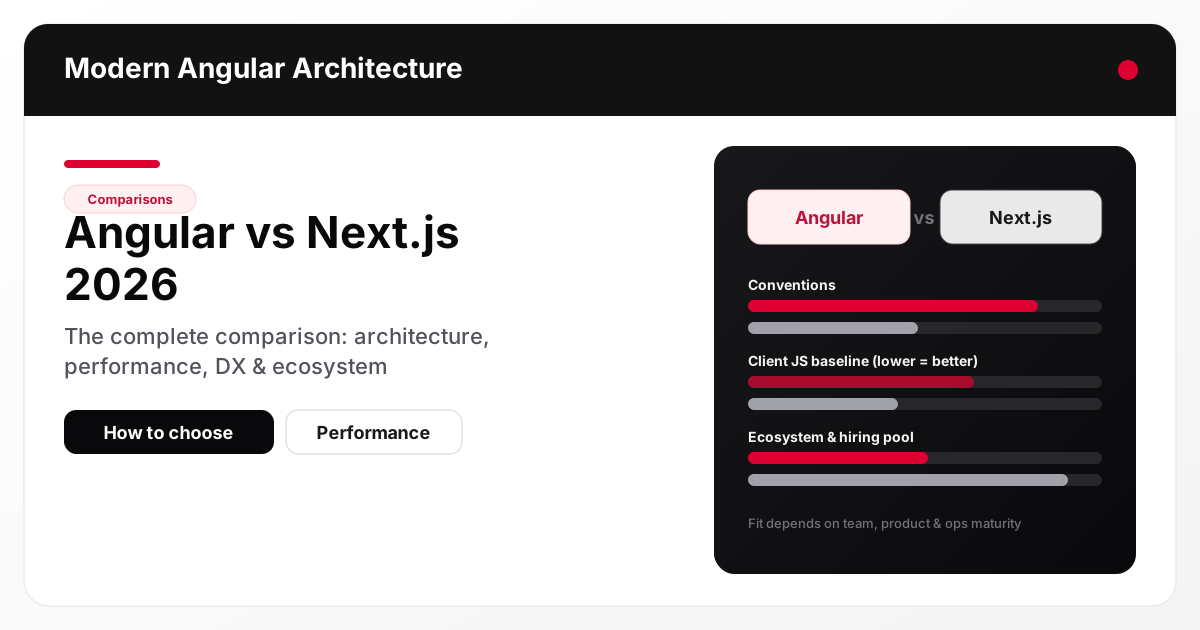
Angular and Next.js are two of the most capable ways to build a modern web frontend in 2026 — but they solve the problem from opposite directions. Angular is a batteries-included, opinionated framework; Next.js is a meta-framework built on top of React . That single distinction explains most of the practical differences in architecture, performance, hiring, and long-term maintenance. This guide is a complete technical comparison for choosing between them on any project. If your decision is specifically about an SEO-driven content site, the focused Angular vs Next.js for content platforms comparison goes deeper on that use case.
TL;DR: the quick verdict
- Choose Angular if you want a single, consistent framework with strong conventions, built-in DI, routing, forms, and architecture patterns that scale across large or multi-team codebases — especially for long-lived, app-heavy products.
- Choose Next.js if your team is invested in React, you want maximum ecosystem flexibility, and you value React Server Components, fast iteration, and a vast component/library landscape.
- Performance and SEO are achievable in both. The deciding factors are team skill, architectural discipline, and operational maturity — not framework branding.
Two different philosophies
The most important thing to understand before comparing features is that these tools occupy different layers.
| Angular | Next.js | |
|---|---|---|
| What it is | A full application framework | A meta-framework over React |
| Comes with | Router, DI, forms, HTTP, testing, CLI | Routing + rendering; you assemble the rest |
| Reactivity model | Signals (with RxJS for streams) | React hooks + Server Components |
| Opinion level | High — conventions by default | Low-to-medium — flexible by design |
| Language posture | TypeScript-first, always | TypeScript-friendly, JS-first roots |
Angular gives you answers; Next.js gives you building blocks. Neither is universally “better” — the right one depends on whether your team benefits more from convention or flexibility.
Architecture and mental model
Angular ships a coherent architecture out of the box: standalone components, dependency injection, a powerful router with route-scoped providers, reactive forms, and an HTTP client — all maintained as one versioned whole. For large teams this reduces decision fatigue and keeps codebases consistent across features. For patterns at scale, see Enterprise Angular feature architecture .
Next.js intentionally provides less. You get file-system routing, rendering modes, and data-fetching conventions; almost everything else (state management, forms, data layer, styling) is your choice from the React ecosystem. This is liberating for experienced teams and risky for inexperienced ones — without standards, two Next.js codebases can look nothing alike.
Rendering models compared
Both frameworks render on the server and hydrate on the client, but the models differ.
Angular uses SSR with full or incremental hydration , prerendering for static routes, and is moving toward a zoneless change-detection model powered by signals. The mental model is “render the component tree on the server, hydrate it on the client, and keep reactivity explicit.” For the production setup, see the Angular SSR & hydration SEO playbook and Angular prerendering vs SSR .
Next.js centers on the App Router with React Server Components (RSC), streaming, and a mix of static generation (SSG), incremental static regeneration (ISR), and server rendering per route. RSC lets you keep data-fetching and rendering on the server by default and ship less JavaScript to the client.
| Rendering concern | Angular | Next.js |
|---|---|---|
| Server rendering | SSR + hydration | SSR + streaming |
| Static generation | Prerender routes | SSG / ISR |
| “Less JS by default” | Zoneless + signals reduce overhead | Server Components ship zero client JS |
| Granularity | Route + component | Component (server/client split) |
In 2026, Next.js has the edge on shipping less client JavaScript by default via Server Components, while Angular’s signals-and-zoneless direction narrows that gap and gives more predictable, fine-grained reactivity.
Performance
For the common query “angular vs next.js performance”: both can hit excellent Core Web Vitals when implemented well, but they get there differently.
- Initial bundle size: Next.js with Server Components can ship very little client JS for content-heavy pages. Angular apps have historically carried a larger baseline, though standalone components, tree-shaking, and zoneless builds have reduced it significantly.
- Runtime updates: Angular signals provide fine-grained, predictable updates without a virtual DOM diff. React relies on its reconciler; well-optimized it’s fast, but re-render management is a common source of real-world slowdowns.
- Hydration cost: Both support partial/streaming hydration strategies. The winner is whoever’s team measures and tunes — not the logo.
The honest takeaway: framework choice rarely caps your performance ceiling. Architecture, image strategy, third-party scripts, and disciplined measurement matter more.
Reactivity and language
Angular’s reactivity is now built on signals — a synchronous, fine-grained primitive — with RxJS reserved for async streams. This makes data flow explicit and easy to reason about. For the boundary between the two, see Angular signals vs RxJS and, for app-level state, Angular signals state management for enterprise teams .
React uses hooks and, increasingly, Server Components. The model is flexible and familiar to a huge developer population, but correct dependency management (useEffect, memoization, re-render boundaries) remains a frequent source of subtle bugs.
Both are TypeScript-capable; Angular is TypeScript-native (it’s written in and assumes TypeScript), while Next.js supports TypeScript first-class but does not require the same structural discipline.
Developer experience and learning curve
- Angular has a steeper initial learning curve — DI, modules vs standalone, RxJS, the CLI — but rewards it with consistency: once you know Angular, you know most Angular codebases.
- Next.js is easier to start, especially for React developers, but the “assemble your own stack” model means real-world projects vary widely, and onboarding depends heavily on the choices each team made.
The Angular CLI (ng generate, schematics, integrated testing) is a notable DX strength. Next.js leans on the broader Node/React tooling ecosystem.
Ecosystem and hiring
This is often the deciding factor. The React ecosystem is larger, so Next.js benefits from more libraries, more examples, and a bigger hiring pool. Angular has a smaller but stable, enterprise-leaning ecosystem with strong first-party coverage (router, forms, HTTP, i18n) that reduces third-party dependency risk.
| Factor | Angular | Next.js |
|---|---|---|
| Hiring pool | Smaller, enterprise-skewed | Very large (React) |
| Third-party libraries | Fewer, but core needs are first-party | Vast |
| Long-term API stability | Predictable, well-documented upgrades | Faster-moving, more churn |
| Dependency risk | Lower (batteries included) | Higher (you own the stack) |
When to choose Angular
- Your team is already strong in Angular, or values strong conventions.
- The product is a long-lived, app-heavy platform with complex domain logic.
- You need consistent architecture across multiple teams or multiple apps.
- You want first-party answers for routing, forms, DI, and HTTP rather than assembling them.
When to choose Next.js
- Your team is invested in React and its ecosystem.
- You want to ship less client JavaScript by default via Server Components.
- You value flexibility and rapid iteration over enforced conventions.
- The project benefits from the large React hiring pool and library landscape.
Can you migrate later?
Yes, but full framework migrations are expensive and rare in practice. The realistic path is a gradual rewrite, surface by surface, behind a routing or proxy boundary. It is far cheaper to make a capability-based decision upfront — based on team skills, product roadmap, and operational constraints — than to switch under production pressure. If your stack involves independently deployed surfaces, Angular micro frontends: Native Federation vs iframes covers patterns that let different teams (and even frameworks) coexist.
Comparison summary
| Dimension | Angular | Next.js |
|---|---|---|
| Type | Full framework | React meta-framework |
| Conventions | Strong, built-in | Flexible, team-defined |
| Reactivity | Signals + RxJS | Hooks + Server Components |
| Client JS baseline | Higher (improving with zoneless) | Lower (Server Components) |
| Learning curve | Steeper, then consistent | Gentle start, varied at scale |
| Ecosystem | Stable, enterprise | Large, fast-moving |
| Hiring | Smaller pool | Large pool |
| Best fit | Long-lived, app-heavy products | React-centric, flexible builds |
FAQ
Is Angular better than Next.js in 2026?
Neither is universally better. Angular wins on convention, consistency, and first-party completeness for large app-heavy products; Next.js wins on flexibility, React ecosystem reach, and shipping less client JavaScript by default. Match the tool to your team and product.
Which is faster, Angular or Next.js?
Both can achieve excellent Core Web Vitals. Next.js ships less client JavaScript by default via Server Components, while Angular’s signals and zoneless direction give fine-grained, predictable updates. Real-world performance depends more on architecture and measurement than on the framework.
Is Next.js easier to learn than Angular?
For developers already comfortable with React, yes — the starting curve is gentler. Angular has a steeper start (DI, RxJS, CLI) but pays it back with consistency across codebases.
Can Angular do everything Next.js does?
Largely, yes: SSR, prerendering/SSG-style output, streaming hydration, metadata, and sitemaps are all achievable in Angular. The implementation patterns differ, and Server Components are a React-specific model with no exact Angular equivalent.
Should I pick a framework based on SEO?
No. Both rank well when SSR/metadata/performance are implemented correctly. SEO outcomes track execution discipline, not framework choice — see the content-platform comparison for SEO-specific detail.
Conclusion and next steps
Angular vs Next.js in 2026 is not a contest for a single winner — it is a fit decision between an opinionated, all-in-one framework and a flexible React meta-framework. Score your project on team skill set, product complexity, and operational maturity, then pick the tool your team can execute and maintain reliably over years, not weeks.
If you lean Angular, start with the Angular SSR & hydration SEO playbook and Angular signals state management for enterprise teams as your implementation baseline. If your decision is specifically about an SEO-heavy content site, read the focused Angular vs Next.js for content platforms comparison next.