 Modern Angular Architecture
Best Apps to Learn Angular in 2026 (iOS and Android Review)
An honest review of the mobile apps you can actually use to learn Angular in 2026 — from dedicated Angular apps to general coding apps with Angular tracks. What each one does well, where they fall short, and which to pick for your use case.
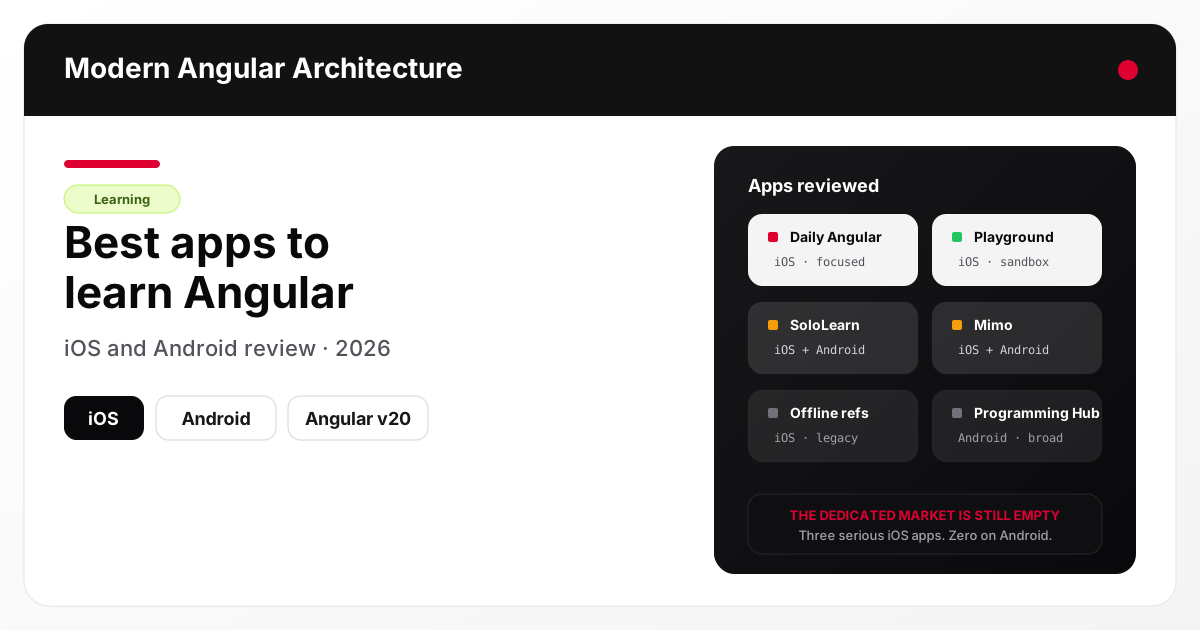
Disclosure: I build Learn Angular , one of the apps reviewed below. I have tried to be fair about what it does and does not do, and to be honest about its competitors — including the one I think is genuinely interesting. If you only trust app reviews written by people with no skin in the game, that is a reasonable position; this is not that review.
If you searched for the best phone app to learn Angular in 2026, you probably expected a top-ten list. The honest answer is that the dedicated Angular app market is unexpectedly thin. There are roughly three serious iOS apps, one or two serious Android apps, and a long tail of offline tutorial wrappers — many of which actually teach AngularJS 1.x, the obsolete 2010-era framework, not modern Angular.
Rather than pad a list with apps I cannot recommend, this article does two things. It tells you what to look for in a phone-first Angular learning app, and then it walks through the apps that actually meet a credible bar — grouped by what they are, not ranked against each other.
Why the dedicated Angular app market is so thin
Angular is enterprise-heavy. Most people who learn it do so through company training, official docs, YouTube courses, or full-length Udemy / Pluralsight content on a laptop. The audience that wants to learn a specific JavaScript framework on a phone in five-minute bursts is real but small, and small audiences rarely support multiple polished apps.
The result is a market split into three buckets:
- A few dedicated Angular apps, mostly built by single developers, varying enormously in quality.
- Cross-platform coding apps like SoloLearn and Mimo, where Angular is one course among many.
- A long tail of “Learn Angular” listings that are actually AngularJS 1.x tutorials in disguise.
The third bucket is large enough to drown out the first two in store search, which is part of why this article exists.
Criteria for a phone-first Angular learning app
Before naming names, here are the five things I would check before installing anything. These hold up regardless of which app wins next year.
- Modern Angular content. The framework changed substantially between v14 and v20 — signals, the new control flow (
@if,@for), standalone components by default,resource(), zoneless change detection. Anything teaching v12 idioms is teaching habits you will have to unlearn. Anything teaching AngularJS 1.x is teaching a different framework with the same name. - Real progression, not just a list of pages. A pass threshold (you have to actually answer correctly to advance) separates “I read it” from “I learned it.” Static tutorials with optional quizzes are books, not courses.
- Genuinely short sessions. “Five-minute lesson” should mean a lesson you can finish on a single subway stop, not a chapter that takes thirty.
- Offline support, or honest about needing the network. A phone learning app you cannot use on the train is a desktop app in disguise.
- Active maintenance. Look at the last update date in the store. A 2024 last-update for an Angular app is already a yellow flag, given the pace of the framework. A 2022 last-update is a red flag.
The apps below are what survive these criteria.
iOS — three apps worth knowing about
The App Store search for learn angular surfaces six apps that primarily describe themselves as Angular learning tools. Four of them are reference-style tutorial readers from a small number of solo developers, often listed under multiple similar names targeting different keyword combinations. They are workable as offline reading material if you are very price-sensitive, but none of them has the structure or maintenance to recommend confidently. The two apps worth talking about in detail are very different from each other, and both worth knowing about.
Learn Angular — structured progression with a pass threshold
Learn Angular is the app I build (App Store , and since mid-2026 also on Google Play ). Three courses — Angular, TypeScript and RxJS — 137 lessons across 28 sections in each language, a 60% pass threshold to advance, English and Spanish, native SwiftUI on iPhone, content covering signals, the new control flow, standalone components, generics and advanced types, and the RxJS operator families (including the switchMap / mergeMap / concatMap / exhaustMap distinction) with interview-style questions throughout. There is no in-app code editor — the lessons are reading + multiple-choice + drag-and-drop ordering exercises, designed for a five-minute session on a phone, not a coding sandbox. (If you want the backstory, I wrote up how I rebuilt it with Claude Code in two weeks — two failed AI attempts, then a shipped app.)
It is the only iOS app I am aware of that applies the Duolingo-style structured-progression model specifically to Angular. The trade-off: you cannot type Angular code into it. If you want to actually run components on your phone, the next app is the one for you.
Angular Academy (Learn Angular: Build Web Apps) — playground with an AI tutor
The most strategically interesting competitor (App Store ). It has the single feature Learn Angular does not: a built-in Angular code editor with live preview. Type a component, see it render. It also includes an AI tutor chatbot for asking conceptual questions when you get stuck, and the curriculum covers modern Angular reasonably well.
If “play with code on the train” is what you want, this is the closest thing iOS has to a Replit-on-mobile for Angular specifically. The curriculum is broader and shallower than Learn Angular’s structured progression, and the AI tutor is a help model rather than a course-progression model — so the two apps overlap less than their store descriptions suggest. Honestly, if you are serious about learning Angular on a phone, using both is reasonable: Learn Angular for the structured drilling, Angular Academy for actually running code.
The reference apps (Learn Angular Development, Learn Angular [PRO], AngularBook, etc.)
Several iOS apps in this category are functionally interchangeable: offline tutorial readers, content roughly similar to a long Medium article series, optional quizzes that do not gate progression. Examples include Learn Angular Development / Offline [PRO] , Learn Angular [PRO] , and Learn Angular | AngularBook . They are fine if you specifically want a cheap offline tutorial bundle. They are not courses, and reviews regularly mention typos and outdated content. I would not pay for a PRO tier on any of them in 2026 when SoloLearn’s free Google-developed Angular course exists.
Android — what is and is not serious
The Play Store has more “Learn Angular” listings than the App Store, but the average quality is lower. A large fraction of them are AngularJS 1.x apps — the obsolete pre-2016 framework — which actively teach the wrong mental model for anything you would build today. Several others are Angular 2 / 4 / 12 era content that has not been updated since the framework’s most important changes.
Of the Android apps that look like real, modern-Angular products in 2026, two stand out:
- Learn Angular — the Android build of the app reviewed above, shipped in mid-2026 (an earlier version of this article said it did not exist yet; it does now). Same structured progression, pass threshold, and bilingual content as the iOS version.
- Learn Angular: Build Web Apps — the Play Store version of the iOS Angular Academy app. Same positioning: code editor, live preview, AI tutor. The playground choice on Android.
A few offline-reference apps (the NgPad family, various “Learn Angular Offline” listings) have come and gone over the past year — some have been delisted, others have not been updated since the framework’s most important changes. If you find one that has been updated in the last six months and the screenshots look like modern Angular, it can serve as a tutorial bundle. I am not going to link specific packages, because the churn on this end of the Play Store is high enough that a recommendation today is likely to be wrong by the time you read this.
When this article was first published, Learn Angular was iOS-only and I said the Android gap was real and could not be waved away. That is no longer the case: the Android build shipped in mid-2026 and is live on Google Play. The structured-course archetype now exists on both platforms.
Cross-platform fallbacks (SoloLearn, Mimo)
Two general coding apps absorb a meaningful share of the “I want to learn Angular on my phone” intent without being Angular apps themselves.
SoloLearn has a “Google Developer Course with Angular” co-developed with Google. It is free, available on iOS and Android, structured into short lessons with quizzes and a community / leaderboard layer, and the content is current enough to take seriously. If you want one free option and one only, this is it. Caveats: the lesson bar is lower than a true pass-threshold course, the experience is platform-wide rather than Angular-specific, and the social / leaderboard model is either motivating or distracting depending on you.
Mimo touches Angular inside a wider front-end career path. Polished UX, paywall early, Angular is not the headline. Worth installing if you want one app that covers HTML / CSS / JavaScript / a framework as a beginner career bundle, but if your goal is specifically “get good at Angular,” it is overkill and underfocused.
A note on apps I would not put on this list: Grasshopper (Google) was sometimes described as “Duolingo for coding” and still shows up in older roundup articles, but it has been shut down — Google wound the project down with its Area 120 incubator, and the app and website are gone. If a 2024 listicle recommends it, that listicle has not been updated. Programming Hub has an Angular track that is shallow even by phone-app standards. Tech-interview apps cover algorithms, not framework questions.
Pick by use case
If you want a single recommendation, here is the shortest version I can give honestly:
- Total beginner, free, one app only: SoloLearn’s Google Angular course. Free, current, available on both platforms.
- Beginner-to-intermediate, willing to pay (iOS or Android): Learn Angular if you want structured progression with a pass threshold; Angular Academy if you want to actually run code on your phone. Both, if you are serious.
- Intermediate, want a sandbox to type into on the go (iOS or Android): Angular Academy. It is the playground app on both platforms.
- Front-end interview prep specifically: Learn Angular. The lessons are framed around the kinds of questions that come up in interviews, which most other apps in the space ignore.
- You need offline reference material and budget is the priority: the offline tutorial apps are fine for that — pick whichever has the most recent update date in the store rather than agonising over the title.
- Android user who wants a structured course in the Learn Angular style: Learn Angular itself, since the Android build shipped in mid-2026. SoloLearn remains the free fallback.
Why the gap exists, and whether it matters
It is genuinely surprising that there is no second structured-progression app for Angular on either platform in 2026 — until mid-2026 there was none at all on Android. Three reasons probably explain it.
First, Angular’s audience tilts enterprise and desktop. The phone-learner segment is real but smaller than for, say, Python or general JavaScript, which makes it a hard market for a solo developer to commit a year to.
Second, building a credible Angular curriculum is more work than it looks. Modern Angular has changed enough that content from 2022 is genuinely misleading, which means an app cannot ship once and coast — it has to keep up.
Third, the playground archetype (Angular Academy) is technically harder to build well on mobile than the structured-curriculum archetype, which keeps the field of competitors in that lane small even where the demand exists.
Whether this gap matters to you depends on what you want from a learning app. If you want a sandbox, you have options. If you want a course in the Duolingo sense of the word — a thing that holds you accountable in five-minute pieces, with a real bar — your choices on a phone are narrow today. That is the gap Learn Angular tries to fill, now on both iOS and Android.
What I will keep watching
A few things would change this article materially:
- Angular Academy adding a real pass-threshold progression would close most of the gap between the playground and structured-course archetypes.
- A new entrant building either of the missing pieces — a structured course on Android, or a strong free-tier interview-prep app — would reshape the recommendation tree.
- SoloLearn deepening its Angular course beyond Google’s introductory framing would make it a more serious standalone choice for intermediate learners.
Learn Angular shipping its Android build would close the platform gap on the structured-course side.Update, July 2026: it shipped — Learn Angular is now on Google Play , and this article has been updated accordingly (as promised, rather than pretending the gap was never there).
If you have used an app I missed — particularly a non-English one or a regional Android listing — I would be glad to hear about it. The point of this piece is to be useful, not to be exhaustive about a market that, today, does not have very much in it.